Essay record
The Case for Talking to Your Computer
- Record
- Essay / / 2 min read / 706 words
On this page3 sections / +
DISCLOSURE: Some links may be affiliate links. Details
I've always been a quiet person who prefers to write than to talk (though this may not be obvious based on the number of YouTube videos I've published).
So it feels a little weird to say that I think talking to your computer is generally more effective than typing on it. But here we are.
In this post I'll explain a bit about why I think this is true and the tools I'm using to do so effectively.
Talking > Typing
Typing still has its place but for a vast majority of usecases, talking will take over.
Historically typing was the primary way to provide input to a computer - at least after the age of punch cards. The mouse came along and many people used that more but typing was still the primary way to input text.
With the rise of LLMs and related tools able to take blobs of text and transform that to computer commands, that constraint is now gone. The bottleneck is moving away from the speed + accuracy of text commands towards the speed of human:ai context transferral.
When typing is useful:
- Precise edits
- Craft / thinking - writing is thinking so taking the extra time to do it manually can deepen your understanding / connection to the piece
- You're in a scenario where talking to your computer may not be great (loud place, convo w friends, etc)
When talking is useful:
- High level direction vs precise edits
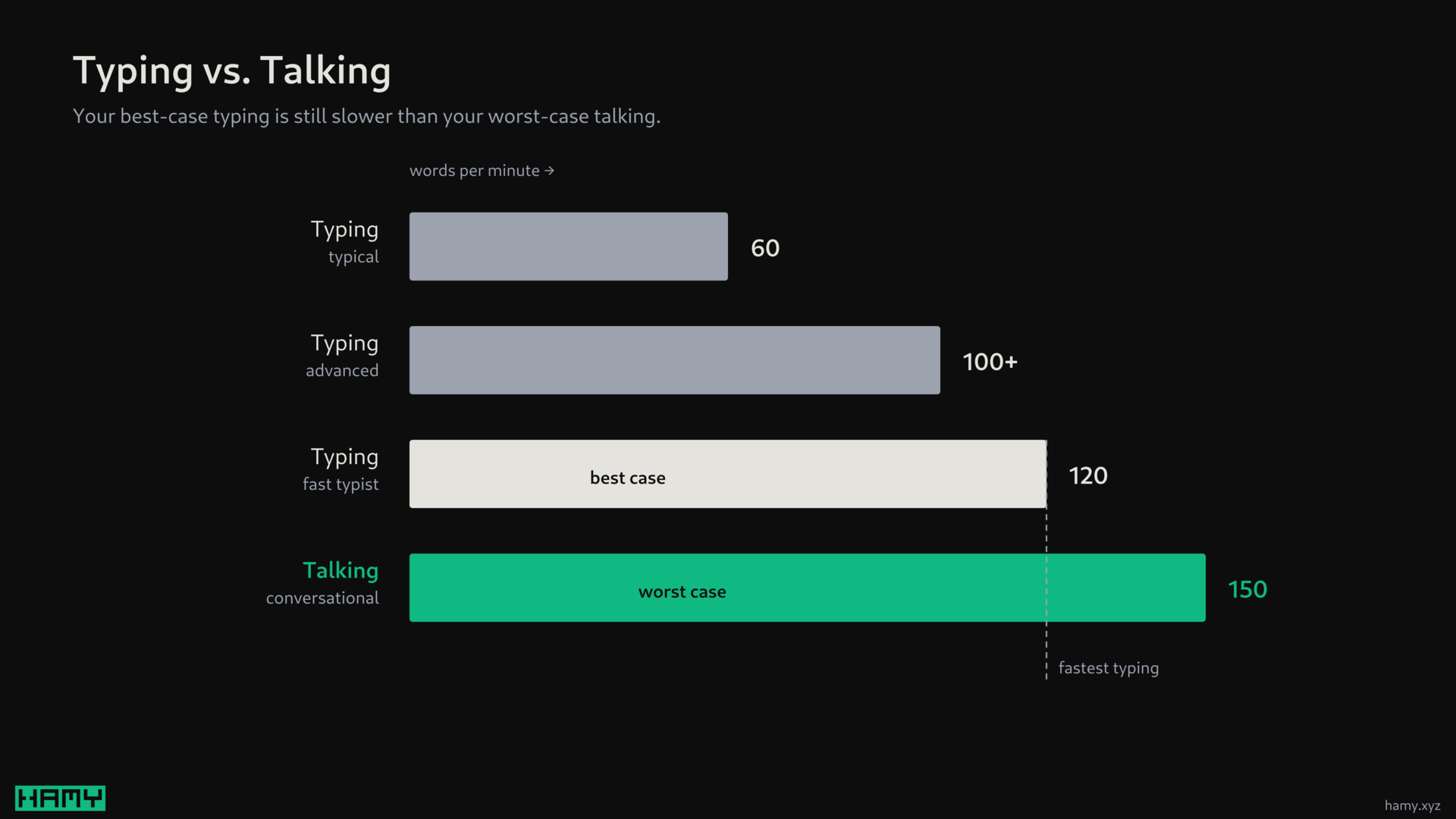
- Transferring a large amount of context quickly - most people can talk about 150 wpm while typical typing speed is closer to 60 with advanced closer to 100+
What I talk to my computer about
I'm a pretty fast typer (~120 wpm) so bumping up from typing to talking isn't that much of a change in raw speed. BUT this typing speed is typically under the best case scenario while talking's 150 wpm is the worst case scenario.
I've been finding that talking for context transferral is way easier on average and requires less of an activation cost - I can walk around the room, stare out the window, use one or no hands, etc.
I've found this useful in many cases:
- Talking through a task at work - including what principles to use, where to find things, etc - typing all this out works too but talking seems like lower lift
- Brainstorming / spitballing ideas - not fully formed, just exploring an area - can get a lot of nuance out and have the AI clean it up
I don't use it for everything though. Some text benefits from slower context transferral - like for writing I like to type it myself so I'm thinking through every word I encode. And generally everything that comes out of AI could use a review / edit pass so if it's going external I still go in with my typed edits.
Next
Going forward I'm going to mainly be talking to my phone / computer. I have to imagine most other people will as well - I think about my mom, brother, and wife who all poke type and how moving to speech is going to vastly improve their ability to interact with their computer.
My current tools for talking to my computer are:
- Work Mac: Wisprflow - company subscription so just use that. Fast, easy, good dictation.
- Personal Fedora machines: Handy - OSS, lots of models to choose from, push to talk same as Wisprflow that works great on my sway setup. Not quite as fast or precise but great for the price, local only, and it doesn't really matter when handing off the bulk of the work to an AI.
- Phone: Built-in dictation on my samsung galaxy
If you liked this post you might also like: