Essay record
The Elephant + Goldfish AI Workflow - Simply Explained
- Record
- Essay / / 1 min read / 490 words
On this page3 sections / +
DISCLOSURE: Some links may be affiliate links. Details
AI is the future and we're all trying to figure out how to use it effectively. The elephant + goldfish AI workflow from Google Distinguished Engineer Dave Rensin has been getting a lot of hype recently.
Here we'll dive into what it is and how to use it, while respecting your time.
What is the Elephant + Goldfish AI workflow?
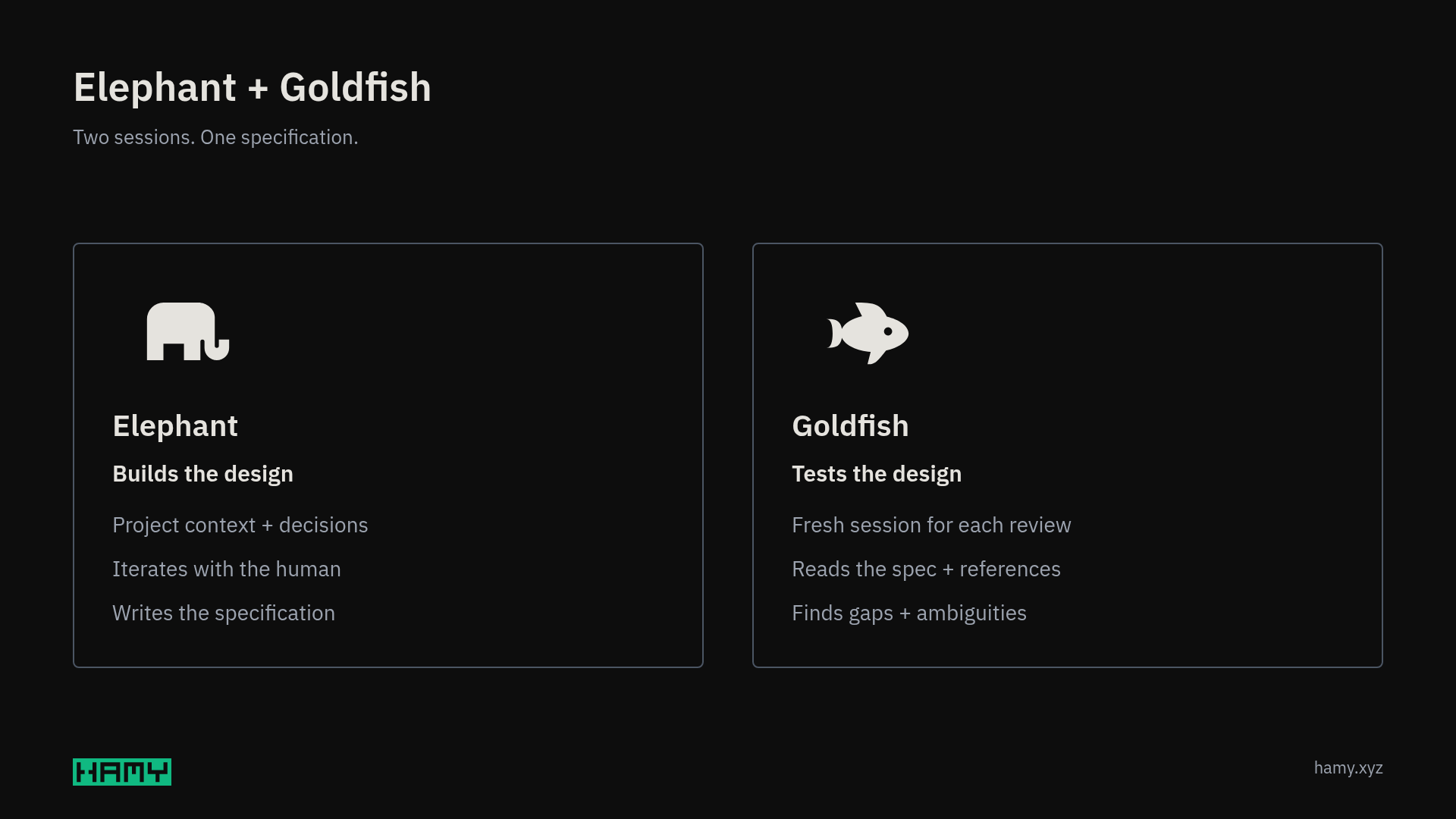
Essentially it's making sure you have an implementer and independent reviewer.
- Elephant - The implementer with all the context, run as agent A
- Goldfish - The independent reviewer, run as agent B (new context with just the output implementation and referenced source material)
The idea is that you then get the benefit of an implementer that understands what you're trying to do which is efficient to iterate with AND the benefit of a new perspective / pair of eyes to review that implementation.
This is similar to best practices found in traditional human orgs like RFC reviews, code reviews, writers/editors, etc. We implement then ask for reviews from many different perspectives to find blind spots, weaknesses, alternative paths, and ways to improve.
How to utilize the Elephant + Goldfish AI workflow
There is an official repo for this approach but you don't really need to use that if you just want to implement the approach.
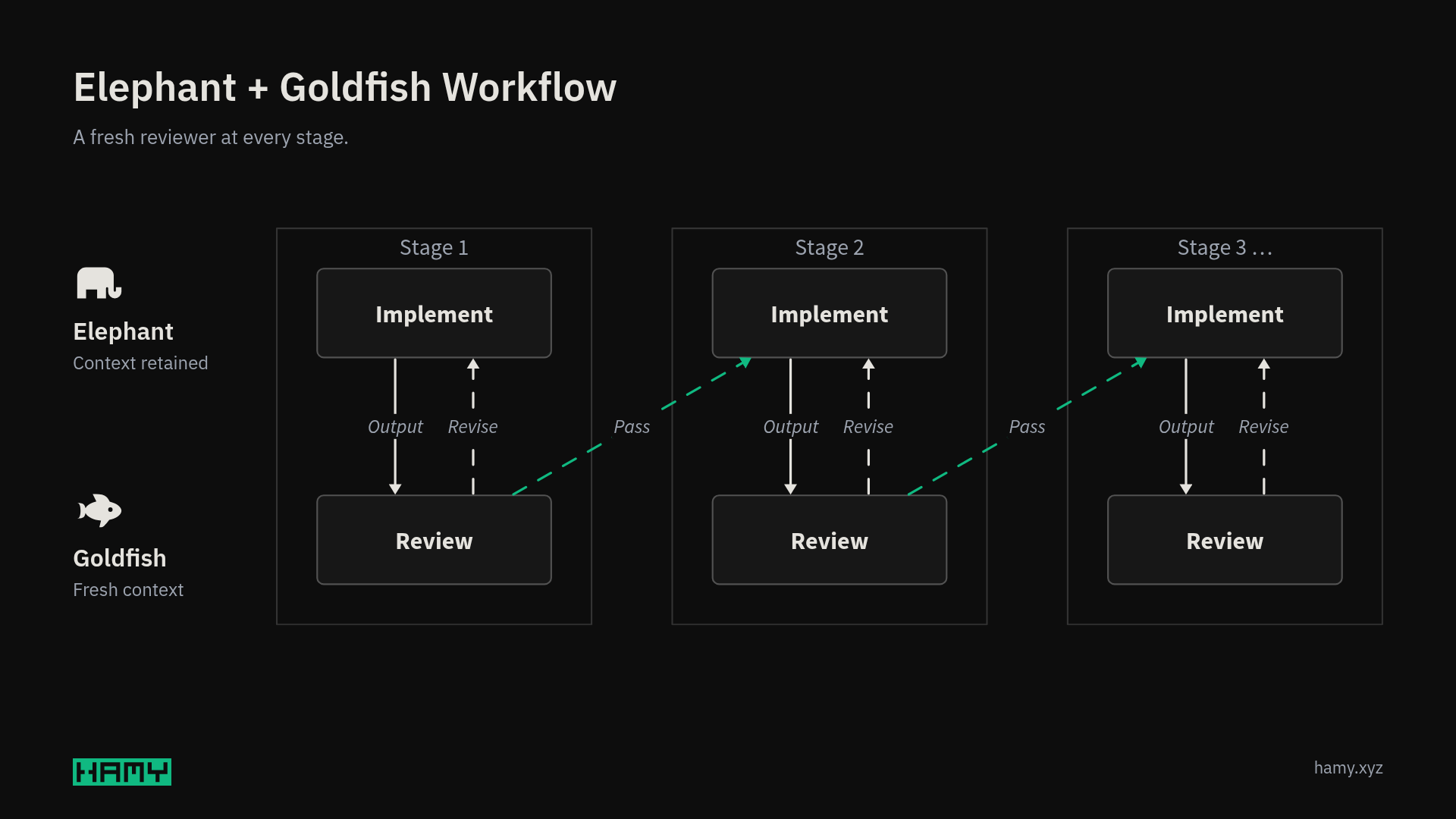
Instead you can just give your agent instructions (via prompt or as lines in your skills / workflows) to do this.
- Manual prompting - Spin up an independent reviewer subagent
- Skills / Workflows - "After x step, spin up an independent reviewer subagent" in your markdown
Some concrete examples of utilizing this approach:
- Spin up multiple agents with different lenses - Like a general reviewer, security reviewer, simplicity reviewer (this is what I do in my agentic code reviews)
- Utilize different model families - I like to spin up a reviewer from both Claude + GPT families and have them align on final feedback for the implementer - this provides more perspectives and covers gaps in their respective strengths / training data.
- Make this the default in your skills - In my agentic engineering workflow I have this kicked off at the end of every plan and implementation phase
Next
So that's the Elephant + Goldfish in a nutshell. Hope that was useful!
I take snapshots of my AI Dotfiles each month so if you want to see that, consider joining HAMINIONS to support more of my work.
Read Next: