Essay record
How AI Killed Tailwind's Business - And How To Avoid a Similar Fate
- Record
- Essay / / 4 min read / 1,035 words
On this page6 sections / +
DISCLOSURE: Some links may be affiliate links. Details
If your main revenue stream is from templates, courses, or small SaaS products AI may already be undercutting your business. That's what happened to Tailwind CSS whose revenue is down 80% since 2023.
I'm particularly interested in this as a majority of my side project income comes from info products like blogs, YouTube videos, and project templates like CloudSeed.
In this post we'll explore what happened, how AI is killing Tailwind's business, and what we can learn to avoid AIs undercutting our own businesses.
What is Tailwind?
Tailwind CSS is a popular styling library, getting ~26M weekly downloads on npm - I even use it to style this blog.
AIs are particularly good at using it because the styling happens inline / close to the underlying markup. This allows AIs to tweak these without needing to understand the whole app's styling / hierarchy which requires loading it into memory which wastes space in its limited context window that could be used for other things.
As such Tailwind is more popular than ever - which makes it so odd that it's now facing an existential crisis.
Tailwind's business is dying
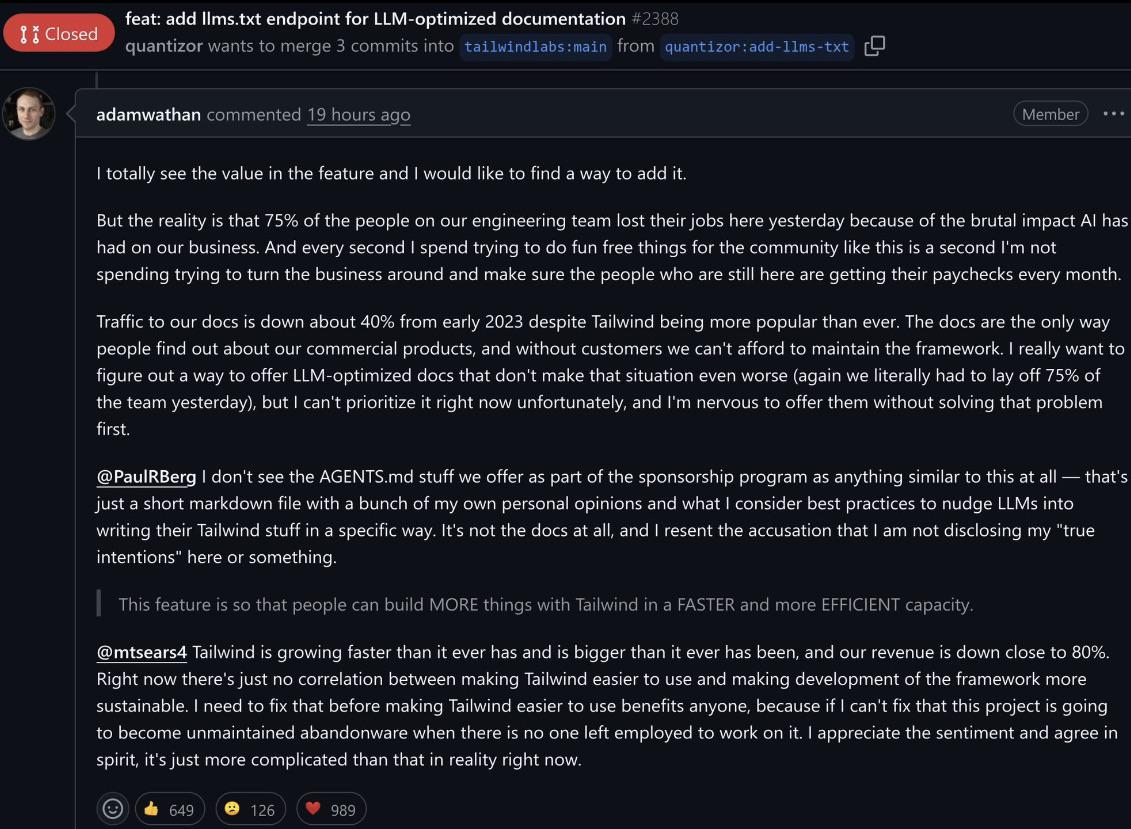
According to Adam Wathan, creator of Tailwind, in a GitHub comment:
- Views to docs down 40% from early 2023
- Revenue is down 80%
- Laid off 75% of engineers (from 4 to 1)
Note: These numbers are self-reported and unverified.
How did AI kill Tailwind's business?
From the data:
- Less people go to docs
- Less people see the ads for Tailwind Plus (a UI templating package they sell)
- Less people buy Tailwind Plus
The leading hypotheses for this are:
- AIs are good enough at Tailwind to not need the docs - So less people look it up, see the ads, and buy plus
- AIs are good enough at UI to not need templates - AIs don't make the best UIs but they're usually pretty good looking and you can continue prompting it to get the look you want. So even those people that are seeing the template ads may not need them - they'll just prompt the AI to do it.
What does this mean for Tailwind?
- Development is slowing down - focused on ways to save the business / keep the project alive vs improving it
- Tailwind will need to find a new revenue source - Some companies are choosing to sponsor the library which may fill the gap somewhat
- The library will likely stick around - It's one of the most popular styling libraries so even if the project loses support, the code itself will be available and it's probable another team will pick up to support it though probably in a less active role
Who's At Risk and How To Defend
AI is rapidly changing the ecosystem - people can now vibe code whole apps, articles, and business plans. So businesses need to provide value AI cannot to stay alive. We should assume that AI will continue to improve though it's unclear if it will plateau in the next couple years or continue doubling for the next 20 - so it's important to continue monitoring its capabilities to stay ahead of the competition.
Templates & boilerplates - If someone can prompt it in an hour, why pay? Tailwind Plus sold UI templates for $300+ that AI can now generate in minutes.
→ Defense: Deep workflow integration. Single-page templates are one-shottable, but full workflows that are maintained long-term are hard to prompt into existence. Think Rippling stitching together HR products or Stripe handling payments end-to-end - that's years of engineering, reliability work, and compliance certifications AI can't shortcut.
Info products (courses, tutorials, blogs) - AI commoditizes pattern-matching knowledge. If your content can be learned by parsing a few dozen projects and books, AI already knows it.
→ Defense: Deep, specialized expertise. Provide knowledge beyond what a generic LLM can spit out. HIPAA compliance, fintech regulations, high-performance distributed systems - domains where the training data is sparse and being wrong is expensive. The more specialized, the less likely AI has good data for it / can be accurate at the edges.
Simple SaaS tools - If the core functionality is promptable in an afternoon, you're competing with free.
→ Defense: Quality so high or prices so low that competing doesn't make sense. AI generates things that "kinda work" - if that's your bar, you lose. AWS S3's eleven-nines durability and price-per-GB are nearly impossible to match with a prompted solution and a couple engineers. Though be careful because many customers don't really care about eleven-nines so competing on quality may not make sense - that's why Zig moved off AWS to self-hosted.
Manual computer work - Scheduling, research, data entry - AI agents are getting good at this fast so will continue to be automated away.
→ Defense: Non-promptable moats. Licenses, proprietary data, API access, regulatory compliance. Stripe and Plaid have banking relationships AI can't prompt its way into. Zillow has MLS data access. These aren't technical advantages - they're legal and relational ones that AI will have a hard time overcoming with purely technical improvements.
Next
AI commoditizes information but not expertise, deep integrations, or high quality / compliance levels. So if your business is just information, it's at risk of being eaten by AI.
For my side projects, I'm thinking about pivoting towards more software tools and domain expertise vs shallow info products. Those worked in the past but the future potential seems low.
CTA: If you use Tailwind and would like to keep it running, consider sponsoring them to keep the project alive and evolving. This is one of the best things you can do to support open source software and is a practice I try to do yearly - evaluating the projects I use and donating to them.
If you liked this post you might also like: