Essay record
How Much I Spend on AI Agents as a Software Engineer (And Is It Worth It?)
- Record
- Essay / / 4 min read / 1,184 words
On this page4 sections / +
DISCLOSURE: Some links may be affiliate links. Details
I've been leaning into agentic engineering for the past six months, and I've finally hit my stride at work after coming back from parental leave.
AI token spend has been a hot topic and we have internal token spend dashboards (leaderboards?) at work so I thought it would be interesting / useful to share my current spend as a full-time software engineer and whether I think it's sustainable or not.
How much I spend on AI each month
Professionally I'm sitting at around $4k/month (~$50k/year), almost all of it on Claude Opus.
Personally I'm closer to $200/month on the Max 20x plan, but I don't push my AI nearly as hard at home as I do at work (largely cause I'm at work, not working on personal projects every day). My personal spend is mostly on side projects and my personal assistant.
While most of this difference is just time spent on projects (8h a day at work vs 0-2h for side projects) I'll also note that I buy most of my personal usage with subscription plans which are largely subsidized by the big labs vs the API pricing they give to enterprises.
What I spend AI tokens on
AI creates 100% of my code now. I haven't written or edited a line of code in months. The closest I get is writing and editing my blog posts which I do in the same editor (nvim btw).
The rough split of who does what:
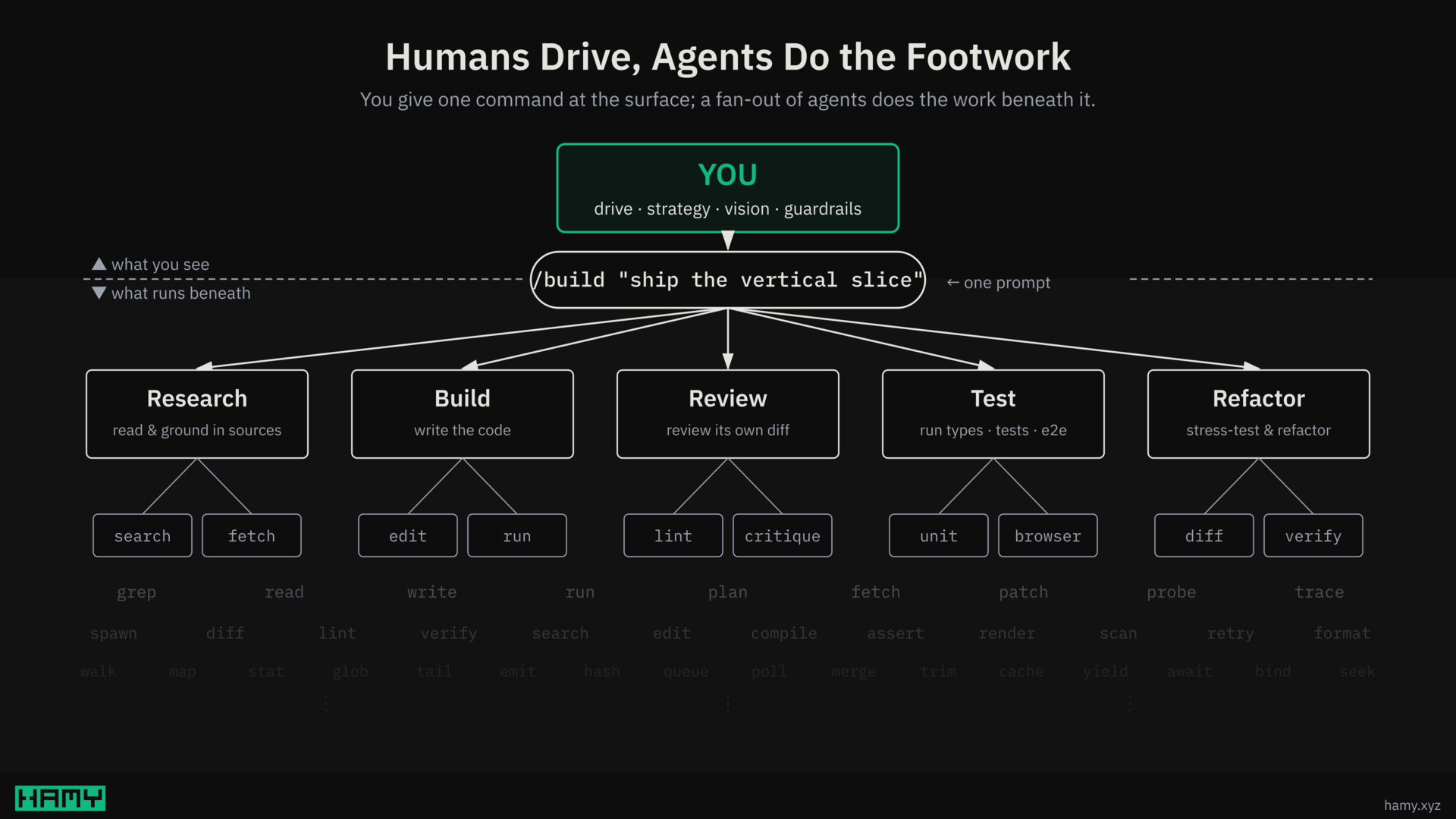
- I drive - direction-setting, priorities, alignment, design decisions, code reviews, and improving the software factory we build in
- AI works - researching, writing code, reviewing code, reading and writing docs
Essentially: I drive, AI builds.
Is it worth it?
Personally, I wouldn't pay $4k/month on tokens - but that's mostly because I don't get much financial value out of my side projects. If I was running a reasonably profitable business then I'd use the below calculations to figure it out.
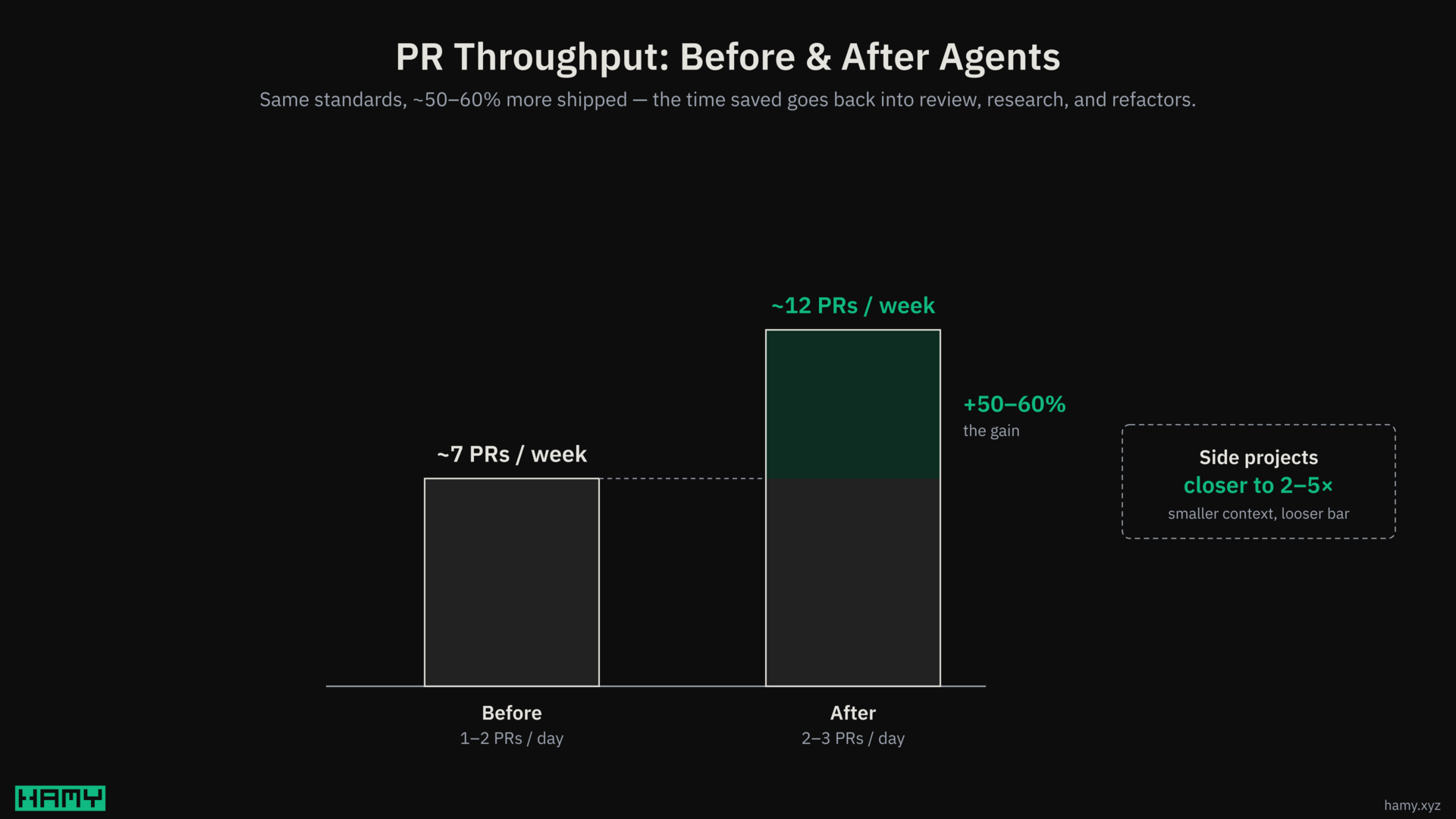
At work it's a different calculation because we do make money and there is a financial cost/benefit in terms of how fast we can ship products to customers. In my deep dive on how I do agentic engineering, I found AI had bumped my throughput by ~60% code-wise. Today it feels higher, maybe closer to 100% - though that's anecdata from the past few weeks so not enough data points to be confident in it.
So to determine if AI spend is worth it we need to put it in perspective of the impact it has.
Say you're a software engineer making $100k:
- Your cost: $100k
- AI cost: $50k
- Speedup: 1.6x
- Your value with AI: Your cost * AI speedup = $100k x 1.6 = $160k
- AI value = Your value with AI - Your cost = $160k - $100k = $60k
- Net AI cost = AI value - AI cost = $10k
At $50k/year in tokens, that's basically a 1:1 trade - you pay to move faster.
It gets better fast if either of these is true:
- You earn more than $100k - at $200k, a 60% speedup is worth $120k, a 2:1 deal
- The speedup is closer to 100% - now it's worth another $100k
Run your own numbers: your value is roughly salary x (1 + speedup), minus the token cost.
Now, these speedups and their impact are hard to quantify.
- What output are we measuring? PRs landed? loc? Projects shipped?
- How do we measure impact? Features shipped? Revenue gained?
- What about indirect effects? More bugs? More maintenance burden?
I don't have the answers and I think the industry is still grappling with these. But I do think with intentional systems you can move faster with AI AND increase quality. If you do that then even at today's prices I think it's a pretty good deal.
There are also a few macro factors at play that I think make this an even better deal short and long term.
Do you have the luxury of NOT accelerating with AI? If all your competitors are burning tokens 1:1 or even at negative impact to go faster, can you afford to be left behind? Maybe if they produce slop but if they're not and releasing bug fixes and new features your customers want? Then in 1 quarter you're weeks behind, in a year perhaps a quarter behind. AI raised the floor and ceiling so without it you may be playing on a different time horizon and you just get swept.
AI will likely become a commodity like computers, electricity, and the internet. Inference today is apparently a pretty great business with gross margins ~60% (source) which tells me there's more room for competition. The open source models are getting better and already SOTA has surpassed what I think is necessary to vastly improve a majority of computing (Opus-level). Open source will likely catch up soon and that will drag down premiums as more people flock to the cheaper prices for good-enough AI for most everyday cases (if I could get Opus for 1/2 the price then I'd do it in a heartbeat). We already see this with the GPT 5.6 vs Fable 5 competition with both sides giving subscribers free tokens to try and keep their base and more companies switching over to GLM5* and Deepseek v4* for more coding workloads. Just wait til it's not 2 frontrunners but 5 and competing against dozens / hundreds of commodity inference providers for the 80% of everyday tasks.
Next
I think AI is here to stay. At typical software engineer salaries, the SOTA coding model math already works (okay maybe not for Fable cause that thing is slow and a token hog but for the other models it's a decent deal). I expect open-source models to keep improving, driving competition and pushing inference toward commodity pricing.
All of this hinges on using AI well though. Run it on a while true loop or point it at shipping slop and it's a net negative no matter how many tokens you burn. But use it like a power tool - the right tool for the job, thinking before acting, careful and intentional - and the gains compound faster than the spend.
Question for you - how much are you spending each month on AI professionally and personally? Do you think it's sustainable?
If you're curious how I use AI, HAMINIONS Members get access to my ai-dotfiles which I snapshot each month.
Read next: